Not sure what help you need? Take a free self-assessment.

"আমার বাচ্চা কথা শুনছে না"
When Bengali Parents Mistake Childhood Anxiety for Disobedience
PARENTINGCHILD
Team Bodhicare
5/27/20266 min read
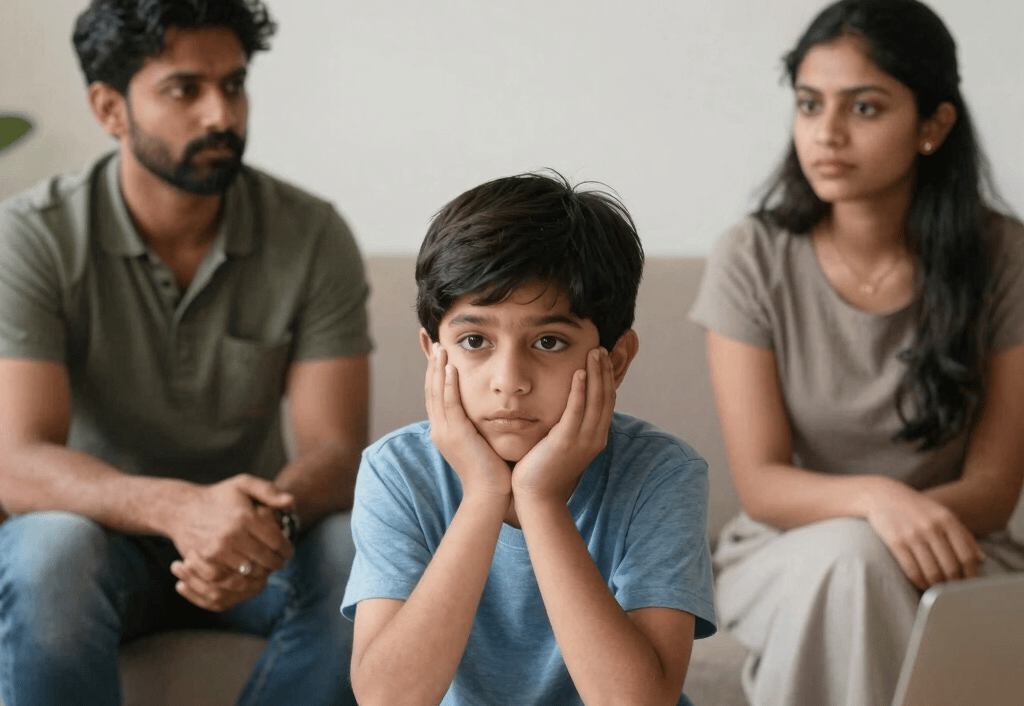
You have said it. Maybe under your breath, maybe to your partner late at night, maybe on a WhatsApp call with your mother back home.
"আমার বাচ্চাটা একদম কথা শুনছে না।" (My child just doesn't listen anymore.)
Or maybe it sounds more like this:
"এত জেদি কেন হয়ে গেছে? আগে তো এরকম ছিল না।" (Why has she become so stubborn? She wasn't like this before.)
"পরীক্ষার আগে এত কান্নাকাটি করে কেন? Drama করছে।" (Why does he cry so much before exams? He's just being dramatic.)
If any of these sound familiar, this post is for you. Not to make you feel guilty — you are doing your best. But because there is something important happening in these moments that is very easy to miss.
Your child may not be disobedient. They may be anxious.
And anxiety in children looks nothing like what we expect.
What We Were Taught About "Good Children"
Most Bengali parents grew up in households where the rules were clear. You respected your elders. You studied hard. You did not talk back. You did not make a fuss.
And if you did make a fuss — if you cried, refused to go somewhere, threw tantrums, or became "too sensitive" — it was managed quickly. A firm word. A comparison to a better-behaved cousin. Or simply: "চুপ করো। এত কিছু ভাবতে নেই।" (Be quiet. Don't overthink things.)
This is how many of us were raised. Our parents were not wrong — they were working with what they had, in a time when mental health wasn't a conversation anyone was having.
But here is what we now know: many of the behaviours that look like disobedience, drama, or defiance in children are actually the way anxiety shows up when a child doesn't have the words for what they are feeling.
Anxiety Doesn't Always Look Like Worry
This is the part that surprises most parents.
We imagine an anxious child sitting quietly in the corner, wringing their hands, looking worried. But that is not what childhood anxiety usually looks like — especially in Bengali households where children are expected to manage their feelings quietly.
Instead, anxiety in children often looks like this:
The child who "doesn't listen" They are asked to go to school, attend a family gathering, or try something new — and they simply refuse. They dig their heels in. They become unreachable. This isn't stubbornness. This is avoidance — one of the most reliable signs of anxiety in children.
The child who cries "for no reason" Before exams. Before school. Before a birthday party. The tears seem out of proportion, even irrational. But for an anxious child, these events feel genuinely overwhelming. The nervous system responds before the rational mind can catch up.
The child with "anger problems" Snapping, shouting, slamming doors — this is often what anxiety looks like in boys, and in children who haven't been given permission to show fear. When a child cannot say "আমি ভয় পাচ্ছি" (I'm scared), that fear comes out as anger.
The child who complains of stomachaches and headaches "পেট ব্যথা করছে। স্কুলে যাব না।" (My stomach hurts. I'm not going to school.) If your child frequently has physical complaints that disappear once the stressful event is cancelled, the body is speaking for the mind.
The child who needs constant reassurance "মা, আমি ঠিক করেছি তো? পরীক্ষায় পাশ করব তো?" (Maa, I did it right? I will pass the exam?) The child who keeps asking the same question over and over, who cannot be comforted no matter what you say — this is anxiety seeking relief it cannot find.
The child who has "become very quiet" Sometimes anxiety doesn't make noise at all. The child who withdraws, who stops playing with friends, who sits alone more than before — this child is often overlooked because they are not causing trouble. But they need attention the most.
Why Bengali Families Miss It
There are specific reasons why anxiety goes unnoticed — and unspoken — in our community. Understanding these isn't about blame. It's about clarity.
"এটা বড় হলে ঠিক হয়ে যাবে।" (They'll be fine when they grow up.)
This is the most common response. And sometimes children do grow out of phases. But anxiety that goes unaddressed in childhood doesn't simply disappear — it learns to hide. It resurfaces in teenage years as academic failure, social withdrawal, or substance use. In adulthood, it becomes the professional who cannot speak up in meetings, the spouse who shuts down during conflict, the parent who passes the same patterns to their own children.
Academic pressure is normalised In Bengali households — whether in Kolkata, Bangalore, or Dubai — educational achievement carries enormous social weight. A child's anxiety around exams is often interpreted as laziness or a lack of preparation rather than a symptom. "আরও পড়ো, তাহলেই ভয় চলে যাবে" (Study more, then the fear will go away) does not address what is actually happening.
Feelings are not discussed openly Many Bengali families are warm and loving — but feelings are expressed through action (feeding, providing, protecting) rather than words. When a child says "আমি ভালো নেই" (I'm not okay), the response is often practical: "কী হয়েছে? কেউ কিছু বলেছে?" (What happened? Did someone say something?) The emotional experience itself isn't validated.
Mental health still carries stigma The word "মানসিক সমস্যা" (mental problem) still carries weight in many families. Parents worry: "কী বলবে লোকে?" (What will people say?) This fear keeps children — and parents — from seeking help long after they need it.
What the Research Tells Us
Globally, between 10 and 20 percent of school-aged children experience significant anxiety symptoms — and most of them go unrecognised and untreated. In India, rising academic pressure, increased social comparison, and changing family structures are all contributing to growing rates of anxiety among children and adolescents. What makes this harder to address is that in Indian school settings, anxiety is still frequently misread as a behavioural problem rather than an emotional one.
The child who is labelled "difficult," "oversensitive," or "not focused" may simply be a child whose nervous system has been in a state of stress for longer than anyone noticed.
What Helps — And What Doesn't
What doesn't help (even when it comes from love):
Telling them to "মন শক্ত করো" (toughen up) — anxiety is not a character flaw
Comparing them to siblings or classmates — this deepens shame, not resolve
Dismissing their fears as imaginary — to an anxious child, the fear is very real
Punishing the behaviour without understanding the feeling beneath it
Waiting and hoping it passes on its own — untreated anxiety tends to grow
What does help:
Name the feeling without judgment. Simply saying "মনে হচ্ছে তুমি এখন একটু ভয় পাচ্ছ, তাই না?" (It seems like you might be a little scared right now, right?) can be more powerful than any advice. When a child feels seen, the nervous system begins to calm.
Don't force avoidance to end abruptly. An anxious child who is forced into the feared situation without support often becomes more anxious, not less. Gradual, gentle exposure — with a trusted adult present — is far more effective.
Keep routines predictable. Anxiety thrives on uncertainty. Stable meal times, sleep schedules, and consistent emotional responses from parents create the sense of safety that anxious children desperately need.
Watch your own anxiety. Children are extraordinarily good at reading the adults around them. A parent who visibly panics, over-explains risks, or catastrophises in front of their child is often — without meaning to — teaching anxiety.
Ask, don't assume. Instead of "কী হয়েছে তোমার?" (What is wrong with you?), try "কী হচ্ছে তোমার মনের ভেতরে?" (What's happening inside you right now?). The second question opens a door. The first closes it.
When to Seek Help
Most parents ask this question too late, not too early. Consider speaking to a professional if your child:
Avoids school, social situations, or activities they previously enjoyed — consistently, for more than a few weeks
Has physical symptoms (stomach pain, headaches, nausea) that appear only before stressful events
Has significant sleep difficulties — trouble falling asleep, frequent nightmares, or needing a parent present to sleep
Cries or has meltdowns that seem disproportionate to the situation, regularly
Expresses fears that feel excessive — about death, illness, something happening to parents
Has become noticeably quieter, more withdrawn, or stopped playing with friends
Says things like "আমি কোনো কাজের না" (I'm useless) or "সবাই আমাকে অপছন্দ করে" (Everyone hates me)
These are not phases to wait out. They are signals to pay attention to.
A Note to the Parent Who Is Reading This at Midnight
You searched for this because something felt off. Because your gut told you this wasn't just "bad behaviour." Because you love your child and you want to understand them.
That instinct is already the most important thing.
You don't need to have all the answers. You don't need to be a perfect parent who says all the right things. You just need to be curious — curious about what your child is feeling, rather than only about what they are doing.
And if you need support figuring out the next step, you don't have to do that alone either.
Talk to Someone Who Understands
At Bodhicare, we work with Bengali-speaking parents and children navigating exactly these questions — in Kolkata, Mumbai, Bangalore, and Dubai. Our sessions are online, private, and conducted in the language and cultural context that feels natural to you.
Whether you want to understand your child better, manage your own parenting anxiety, or figure out whether your child needs professional support — we can help you find clarity.
📞 Book a Parenting Clarity Session with Bodhicare Your first conversation starts here → https://bodhicare.space/book-your-session
আপনার বাচ্চাকে বোঝার চেষ্টা করছেন — এটাই সবচেয়ে বড় পদক্ষেপ। (Trying to understand your child — that is already the biggest step.)
Bodhicare provides online mental health and emotional wellbeing support through qualified professionals. This article is for awareness and general information only and is not a substitute for professional clinical advice. If you are concerned about your child's mental health, please consult a qualified professional.