Not sure what help you need? Take a free self-assessment.

ঘুম হচ্ছে? Are You Actually Sleeping Well?
61% of people get less than 6 hours of uninterrupted sleep. 47% wake up feeling exhausted. Poor sleep isn't just tiredness — it's a mental health signal. Here's what the science says.
SLEEPSLEEP PROBLEMS ANXIETY,
Team Bodhicare
5/29/20265 min read
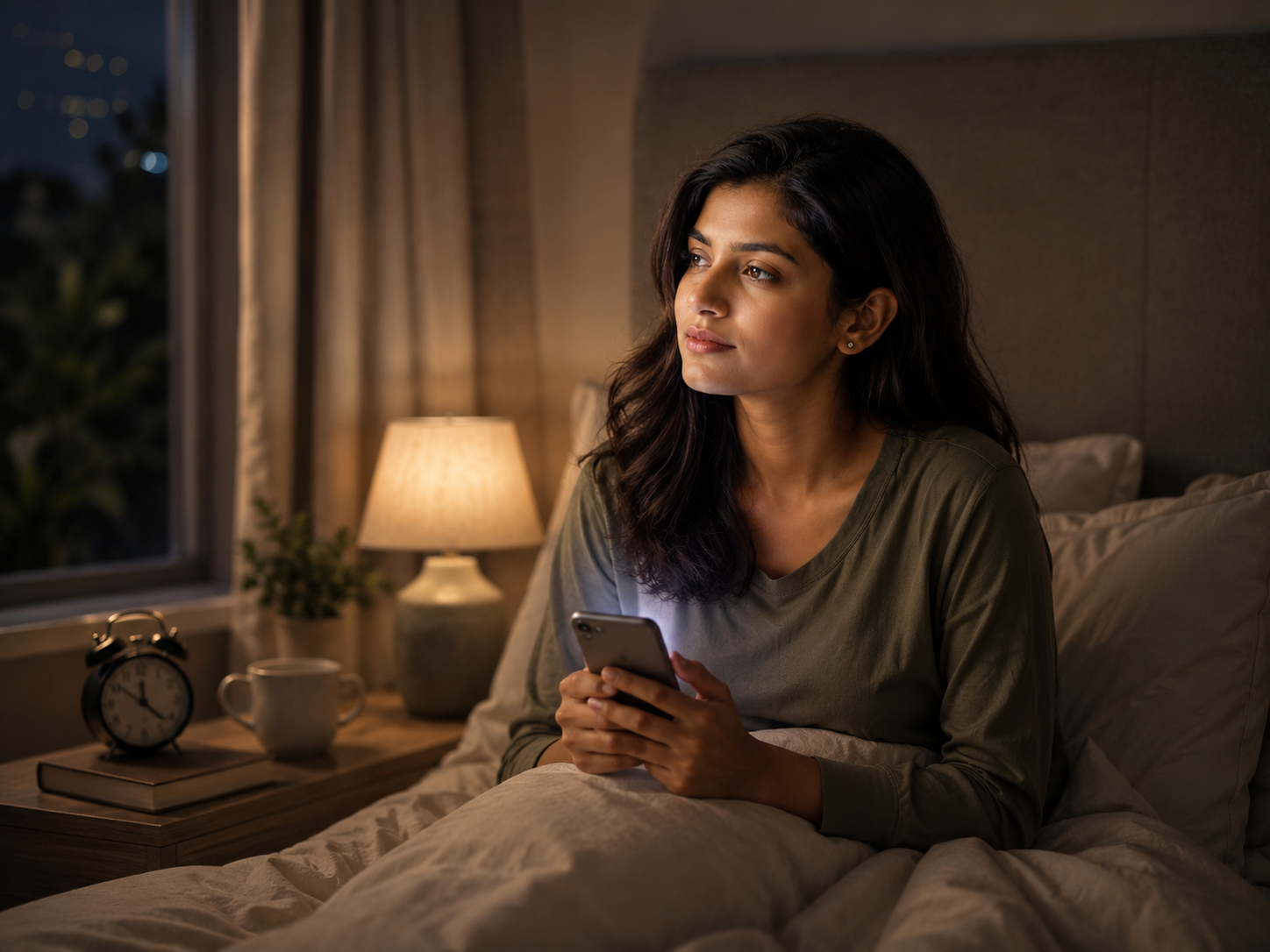

My post contentঘুম হচ্ছে? Are You Actually Sleeping Well?
By Bodhicare | Sleep & Mental Health | 6 min read
Most people would say yes.
Most people would be wrong.
Sleeping and sleeping well are two different things. You can spend eight hours in bed and wake up feeling like you've been dragged through gravel. You can fall asleep the moment your head hits the pillow and still spend half the night in shallow, restless cycles that leave you foggy and irritable by noon.
So the real question isn't how many hours. It's what is happening to your brain and body during those hours — and whether you are giving it the conditions it actually needs.
The Numbers Are Hard to Ignore
A 2024 LocalCircles survey of over 41,000 people across 309 districts found that 61% reported fewer than six hours of uninterrupted sleep per night — a 6% rise from the previous year.
In Kolkata specifically, the numbers are just as stark. According to the Wakefit Great Indian Sleep Scorecard 2025, 46% of Kolkata residents go to bed after 11pm, and 47% do not feel refreshed after waking up. A striking 89% wake up at least once or twice every night.
Sleep deprivation is now one of the top three reasons people call tele-MANAS, the government's mental health helpline — which receives 3,500 to 4,000 calls daily, with at least 300 directly related to sleep issues alongside sadness and anxiety, according to Dr. Naveen Kumar of NIMHANS.
This isn't a lifestyle inconvenience. This is a quiet mental health emergency.
Why You're Not Sleeping — The Real Reasons
We tend to blame screens. Screens are part of it, but they are rarely the whole story. The root causes of chronic poor sleep are usually layered:
Anxiety and rumination The most common culprit. In the 2025 Sleep Scorecard, 35% of respondents said they stay up worrying about the future. When the nervous system is activated — when the mind is running through tomorrow's meetings, unresolved conversations, or nameless dread — the brain cannot transition into the slower waves needed for deep sleep. You lie down. Your mind does not.
Irregular sleep timing Your body runs on a circadian rhythm — a roughly 24-hour internal clock that regulates when you feel alert and when you feel sleepy. Late nights on weekdays, sleeping in on weekends, and shifting meal times all disrupt this clock. Once disrupted, it doesn't self-correct quickly. Your brain stops trusting when night is.
The "tired but wired" cycle This is extremely common among working professionals. The body is exhausted but the cortisol levels — the stress hormone — remain elevated long after the workday ends. The result is fatigue without drowsiness. You want to sleep. Your body won't allow it.
Conditioned wakefulness If you have spent enough nights lying in bed unable to sleep, your brain begins to associate the bed itself with wakefulness and frustration. This is called conditioned arousal — and it is one of the most underrecognised reasons why sleep problems become chronic. The harder you try to sleep, the more alert you become.
What we eat and when Heavy late dinners, cha (tea) after 6pm, and even that small cup of coffee after lunch — caffeine has a half-life of five to seven hours, meaning half of it is still in your bloodstream when you try to sleep. রাতের ভারি খাবার (heavy night meals) delay digestion, raise core body temperature, and keep the system running when it should be winding down.
What Actually Works — Evidence-Based Techniques
This is where most sleep advice goes wrong: it offers tips. Don't use your phone. Try chamomile tea. Count sheep.
These are not useless, but they are incomplete. What psychiatrists and sleep medicine specialists actually recommend for chronic sleep problems is a structured, evidence-based approach — not a checklist of habits.
Cognitive Behavioural Therapy for Insomnia (CBT-I)
The American Academy of Sleep Medicine has issued a strong guideline — meaning clinicians should follow it under most circumstances — recommending CBT-I as the first-line treatment for chronic insomnia. Not sleeping pills. Not melatonin. Therapy.
CBT-I produces results equivalent to sleep medication, with no side effects, fewer relapses, and a tendency for sleep to continue improving long after treatment ends.
It works through five core components:
1. Sleep Restriction Therapy Counterintuitive, but one of the most effective techniques known. It works by reducing the time spent in bed to match the time actually spent sleeping, which improves sleep efficiency — the percentage of time in bed when you are genuinely asleep. As efficiency improves, time in bed is gradually extended. The result: the brain relearns to associate bed with sleep rather than wakefulness. This is particularly effective for people who lie in bed for hours before sleeping.
2. Stimulus Control Stimulus control addresses conditioned arousal — the state where the bed has become associated with anxiety and wakefulness rather than rest. The approach involves minimising activity in bed unrelated to sleep, and getting out of bed if sleep doesn't come, returning only when genuinely sleepy. It sounds simple. It is profoundly effective when done consistently.
3. Cognitive Restructuring This helps identify and confront unhelpful thoughts about sleep — the catastrophic thinking that keeps people trapped: "If I don't sleep, I'll fail tomorrow." These beliefs themselves generate the anxiety that perpetuates insomnia. A therapist helps you examine what you believe about sleep and replace those beliefs with accurate, calming ones.
4. Fixed Wake Time One of the most consistent recommendations from sleep specialists: pick a wake time and keep it — every day, including weekends — regardless of how well or poorly you slept. This anchors your circadian rhythm and rebuilds the body's sleep pressure. It is uncomfortable initially. It works.
5. Progressive Muscle Relaxation (PMR) A technique recommended across psychiatric guidelines for anxiety-related sleep problems. You systematically tense and release muscle groups from toe to head, signalling to the nervous system that it is safe to release vigilance. It is especially effective for people who carry physical tension — tight shoulders, clenched jaw, সারাদিনের ক্লান্তি (all-day exhaustion) that never fully unloads.
A Note on Melatonin
It has become the default solution for anyone who can't sleep. A melatonin gummy before bed has become as normal as brushing teeth.
Melatonin is a hormone that signals when to sleep, not how deeply. It can help with jet lag and circadian rhythm shifts. For chronic insomnia driven by anxiety, rumination, or conditioned wakefulness, it addresses none of the root causes. It is not a substitute for CBT-I.
When Sleep Becomes a Mental Health Signal
Poor sleep is not only caused by stress — it also creates it. Chronic sleep deprivation amplifies anxiety, reduces emotional regulation, impairs memory, and over time raises the risk of depression significantly.
If you have been sleeping poorly for more than three weeks, and particularly if it is accompanied by mood changes, inability to concentrate, or the sense that nothing is enjoyable anymore — this is worth talking to someone about.
Not because something is seriously wrong. But because sleep is where the mind repairs itself. When that process is interrupted long enough, everything else begins to follow.
Talk to Someone Who Can Help
At Bodhicare, our qualified professionals work with sleep difficulties, anxiety, and stress — the three conditions most often found together. Sessions are online, private, and available in Bengali and English.
If you are lying awake tonight wondering whether this is worth addressing — it is.
Book a session at bodhicare.space
ভালো ঘুম মানে শুধু চোখ বোজা নয় — মনকেও বিশ্রাম দেওয়া। (Good sleep isn't just closing your eyes — it's giving the mind rest too.)
Sources: LocalCircles 'How India Sleeps' Survey 2024 | Wakefit Great Indian Sleep Scorecard 2025 | NIMHANS / tele-MANAS data (March 2025) | American Academy of Sleep Medicine Clinical Practice Guideline on CBT-I | PMC — Cognitive-Behavioral Therapy for Insomnia (Plosive et al.) | Mass General Hospital Sleep Medicine
This article is for general awareness only and is not a substitute for professional medical or psychiatric advice.